
Epsilis Web Design
T: 01279 295546
E: joseph@epsilis.co.uk
Content 101: How to Write Good Website Copy

Writing good website copy is essential to get you noticed. We are all bombarded by content on websites and social media, competing for our attention. So make sure your content doesn’t get ignored.
Writing good copy is hard work but very rewarding. Good web content is unique, well written and interesting. As well as audience-focused, easily read and search engine optimised.
This guide tells you how to write good website copy and provides loads of tips for effective copywriting. So read on and see how you can create great content for your site.
Table of Contents
Make your Copy Stand Out From The Crowd
First: your web copy must be worth reading.
Obvious, I know, but most of the time, in my experience, this is not the case. The internet is overflowing with poor copy, often written in the name of SEO.
Everybody wants their website to be prominent in the search engines. Of, course they do!
So what is the answer – SEO?
But SEO only works if the copy is good and people want to read it.
So there you have the secret.
Write what people want to read.
So stand out from the crowd. Make sure your content makes interesting reading. Otherwise, you are unlikely to see any return from all the effort you put in to writing your copy as no one is reading it. Regardless of SEO.
Myth busting: “People don’t read long web pages” – WRONG!
Let us deal with this myth early on. I have heard this so many times:
“People don’t read long web pages, they put them off . I want short web pages with very little content for my website.”
But this is wrong thinking.
Search engines favour more, rather than less content and are influenced by backlinks.
Short web pages with little content usually mean a poor website, that gets few visitors and does not trouble the search rankings. Is that what you want?
I agree, busy web pages with lots of boring content are seldom read. Web pages should not include unnecessary content, be it text or images. People are looking for information, so give them what they want and make sure it is well presented.
There is so much competing for our attention. Most of us wade through lots of noise to find something we want to read. So we scan titles and headlines, skim sub-headings. We stop when something sparks our interest, then and only then, we read more.
People will read what interests them if they can find it.
Content should be well written and presented clearly. It has to be easy to digest, scan well, interest and draw in the reader.
Also, why content should not be the minimal:
- We expect to find out everything we want to know on websites.
- A couple of paragraphs is not going to impress anyone researching your company, services or products. But may give them a poor impression! See FAQ: How much text do I really need on my web pages?
- Search engines always favour good quality comprehensive content.
- Google wants to find the best fit answer to the search query.
- Good content attracts links which helps SEO significantly.
- People share good quality content on social media which is great for your marketing.
- Search engines rank pages higher if visitors spend more time on them.

Before “how to write good website copy”: comes “what are you going to write?”
When thinking about what to write there are 4 key points to be made:
- Who is your target customer? Focus on someone specific. the more specific the better. Don’t aim for everybody as you will miss everyone.
- What is their problem you are able to solve? Get peoples’ attention by focusing on their problems and pain points and provide your ideal solution.
- Think benefits not features. What is in it for your target customer? People are far more interested in what affects them and not interested in what effects you.
- What are your Keywords? What is the common language of your target customer. What are they looking for? What do they want to know? Target them by using relevant keywords. It is best to sort these out beforehand then your writing will be focused on what matters and has impact.
Keywords: This is always the biggest problem I face when ask to improve the SEO of a site. The content is written without thinking about keywords. So SEO has no focus and can’t be done effectively without re-writing everything!
What is Search Intent all about?
When a searcher types a query into a search engine, they are not just looking for pages that contain those words.
They want to find the answer to their query.
Search Intent is about understanding why people are searching, what is their goal when typing that search phrase? And writing your content to match their goal.
This is what the search engines aim to do.
Match the best answers to the search queries. And it is what people want to see come back from their search. Good, relevant search results.
The 4 main types of search intent usually quoted are:
- Informational intent. They are looking for information. Their search may include words like “how to, guide for, why, where to find, what is…”
- Navigational intent. They know what they are specifically looking for (such as a brand or product) and want a link to that website or page. Their search may include plus words like “a brand website, for example: Lego website or gmail login, terms and conditions, price…”
- Commercial intent. Considering buying but need more information to help them decide. Their search may include words like “best, review, compare, top, alternative to…”
- Transactional intent. People are ready to buy. Their search may include words like “buy, discount, sale, coupon, offer, quote, cheapest…”
For an expanded and user friendly explanation of search intent see the Search Engine Land article: There are more than 4 types of search intent.
Matching your content to search intent gives you a much better chance of performing well in the search results for the queries relevant to you.
Other key tips include:
- Be yourself. People buy from people they like, can relate to, get what they are saying. So don’t pretend to be some one else, it won’t work.
- Be helpful. Freely provide information. Don’t worry about giving away secrets. People will come back for more if they see you are honest and forthcoming.
- Create credibility. If you want to be seen as an expert in your field then show your knowledge and experience. Add statistics and data, diagrams, reviews and testimonials etc… to back up what you are saying.
Need more help on “What to Write”:
You can find
- A checklist of what to write about for your website and social media in this article.
- A handy list of FAQ starters in this article.
- A list of Common Web Pages and their content found on most sites in this article.
First: Capture interest immediately with a good title
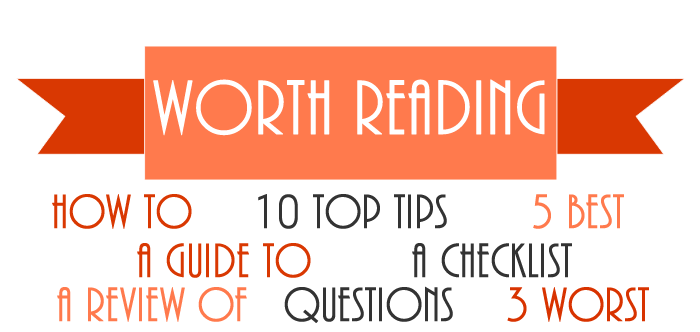
Headlines are used to judge whether to read further. So your title must grab attention and promise your copy is worth reading.
Good titles often begin with or include:
- How to …
- A guide to … (beginners, complete, quick, DIY)
- 10 top tips … (any number, handy tips, tricks, hints)
- Questions you should ask …
- A checklist …
- A review of …
- 5 best … (any number, worst)
See my article on How to Write Great Headlines. Spend time on this, it is the key factor in getting your content read.
Great content with a poor title gets overlooked.
Titles: Human readers v search engines – so which is it?
There is no real conflict if copywriters allow for search engine requirements:
- Titles written using the common language of the human visitor and searcher.
- Including keywords people are using in their searches.
- Avoid clever wordplay that a person would spot but a search engine might miss.
- Longer titles are acceptable – 2 or 3 words doesn’t leave much scope, use 5 or 6, up to 10 if needed.
Next: Start with an introduction
If people like your headline then they will read your first sentence or paragraph. So keep them interested by making it clear what your article is about from the start.
- What is the main point of your piece? Summarise what the article is about as briefly as possible.
- Let the reader know what they will gain from reading the rest of your article.
- Keep your first sentence short.
- Don’t repeat your headline but do reinforce it.
- Include your most important keywords and some other relevant keywords .
- You could highlight one or two important points of your article.
- Refer to problems or questions the reader wants to be answered.
- Keep your introduction short.
- Use You and Your to tell the reader you are writing for them.
We are looking for information. Don’t make us work hard to find what we are looking for.
Then: How to improve scannability with sub-headings
Sub-headings should stand out, break up your text and lead you through the subject. Plenty of white space and short paragraphs improves presentation and will encourage people to read more.
A wall of text is daunting. If you make it difficult, people will look elsewhere.
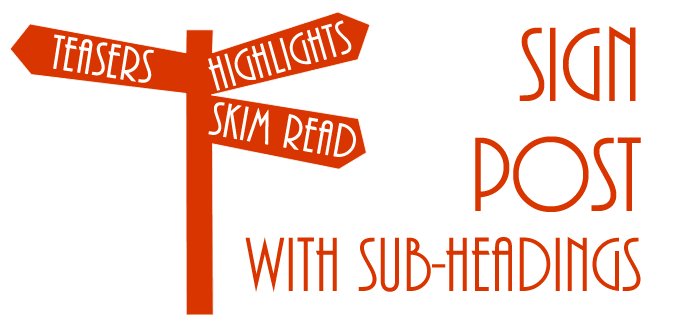
Sub-headings need to inform, tantalise and promise something useful is following.
- They are teasers to keep you reading.
- Sub-headings give you the highlights.
- And sign post what is ahead.
- They help you skim read.
- And make it easier to find the information you are looking for.
Think about benefits and rewards for your readers:
- Questions can make good headings.
- What are their pain points?
- What are they going to gain from reading this?
- Is it relevant them?
Motivate readers to look for the ‘win’ for them in your article.
To improve SEO use keywords in all your sub-headings when you can.
We are looking for answers to their questions. So make it easy for us by putting questions in your title and sub-headings. See my article: How to Copywrite for People and Search Engines with QandAs.
Top Tip: If you read only the sub-headings
- Do they give you an overview of the page?
- Are they helpful and informative?
- Are they leading you through the story?

Always: Keep your text simple and easy to understand
Keep your text as simple and straightforward as you can. Short words, short sentences, short paragraphs are easier for us all.
You can deal with complicated matters, just don’t make them more complicated than they need to be.
Everything should be made as simple as possible, but not simpler.
Albert Einstein
Short paragraphs, not solid banks of text
Paragraphs should be no more than 5 sentences, less is better. Short paragraphs are easier to read. Long paragraphs are hard work and will put people off.
Each paragraph should focus on only one topic. New topic = new paragraph.
- Split up long paragraphs.
- Add sub-headings. They add space to breathe and reflect on what you are reading.
- Use lists instead:
- Lists are excellent for splitting information up.
- They allow complicated ideas to be divided into manageable chunks.
- Lists visually break up text, making it more inviting to read and scan.
- They let people digest more information.
- Lists make key information stand out.
- They are a simple way to bring order, clarity and focus to your writing.
Sentences and words should be easy to understand
Most sentences should be short: 15 to 20 words is ideal. Shorter is fine, occasionally longer is also fine.
- Have one idea per sentence.
- Split sentences up if they are too long.
- Don’t be afraid of starting a new sentence with AND, BUT, SO, BECAUSE, OR to keep sentences short.
- Don’t use long words when short words will do the same job and suit a wider audience.
- Do vary your words to avoid being repetitive and boring.
Make your writing more pleasant with rhythm
Varying sentence length gives your writing rhythm making it more enjoyable to read.
- Use longer sentences to lead the reader through.
- Use very short sentences to punctuate your writing and make a strong point.
Here is a terrific explanation of How to Vary Sentence Length to great effect.
Write as if you are having a conversation
Write as if you are talking to one person.
Your writing will flow better and be more accessible if you write in a conversational tone. So how do you do this? Adding questions, like I just did, is one way.
Asking questions is an excellent way of relating to the reader and making it feel like you are talking specifically to them.
“Did you know…” is a good one to start a subject. Don’t ask too many questions though as you do not want to set your reader’s mind wandering away.
Using conversational transitions is another.
“Let me show you…” is a good conversational transition from a question or problem to the answer. So is “Now…”. I am sure you can think of many others you use in conversation.
Adding personal details about your self, your surroundings or your thoughts can be another. Thereby painting a picture in the mind of your reader so they are with you in the moment.
Use words wisely
Power words have more impact on your readers. Using them will help get your message across. Here are some of the most common power words used in marketing. You will see these all the time because they work:
- Because
- Free, Value and Premium
- Instantly and Now
- New and Latest
- Included and Exclusive
- Imagine and Discover
- Secret
- Unique and Best
- Opportunity
- Benefit and Results
- Amazing
- Safe and Risk-free
Make it personal
Use you, your, my, mine, we, I…
When referring to your reader use ‘you‘. When referring to something related to your reader use “your“. Write as if you are speaking to a real person, not a generic group.
It is ok to mix I and we if it sounds right.
Verbs: Be active rather than passive most of the time
Using an active voice makes sentences shorter, more direct and punchy, for example:
Active verb: Michael wrote this article.
Passive verb: This article was written by Michael.
Writing with a passive voice adds extra words and softens the message. See Grammarly’s guide to Active Voice vs Passive Voice.
Sometimes a softer approach is appropriate. You do not want to accuse or cause offence. For example, when dealing with unpaid bills, emails you didn’t receive, or mistakes made. But generally active is best. This is a good article on How to Use the Passive Voice Correctly.
Top tip: Remove redundant words. Use the least number of words to be more direct. saying simply what you mean.
Adverbs: do you need them?
Adverbs are used to modify your message, perhaps soften or harden the affect. Examples include:
- Quickly, Slowly, Badly, Loudly, Excitedly, Seriously, Slightly…
They may be helping to paint a clearer picture.
But don’t overuse adverbs like:
- Really, Very, Quite, Rather, More…
These can usually be removed and will improve your writing.
- See Grammarly’s guide to What is an Adverb.
- This article on How to Use Adverbs Correctly includes 4 helpful rules on removing adverbs.
Use transition words to link statements together
Transition words (or phrases) are useful as they link one statement to another. They bring more order and flow to your writing. Making it easier for your reader to relate ideas you express. Transition words include:
- Number or order related = first, one, second, lastly, finally…
- Adding to = and, in addition (to), also, further, moreover, equally (important)…
- Emphasis = above all, most importantly…
- Opposing = but, however, on the contrary, while, despite, unlike…
- Effect = because, therefore, consequently, as a result, due to, so that, hence, whenever, for this reason…
- Example = for example, for instance, notably, particularly, significantly, such as…
- Timely = now, once, occasionally, every so often, before, after, all of a sudden…
- Finishing = in summary, in conclusion, finally, overall, altogether…
Emotional Words
Emotional words relate to feelings like happiness, sadness, fear, and anger. Emotional words get an emotional response and so have a bigger impact. People make more decisions based on how they feel rather than rationally evaluating information.
Just keep it real, please. If there is too much sensationalizing going on words lose their impact.

Finally: Finish with a conclusion
Outline your main point and give your conclusion.
- Summarise as briefly as possible. What is the main takeaway for you readers?
- Cover what has been learnt from your article.
- If there is a follow-up or more information elsewhere then sign post to that.
- Include a Call To Action (CTA).
- Keep your conclusion short.
- Use You and Your to tell the reader you are writing for them.
Leave your readers satisfied that you have dealt with your subject. Don’t leave them thinking “So What?”
Now improve: Edit and revise what you have written
Most of us are not gifted with the ability to write briefly and clearly the first time. We tend to add extra words to soften the message, we ramble around the point and mix up our ideas.
Top Tip: Read what you’ve written out loud slowly.
- Does it sound right?
- Does it flow comfortably? If you are tripping over any words, or having to re-read parts, then it is not right yet.
- Is it as good as you can make it?
Don’t go with your first draft – edit, simplify, remove clutter, smooth out the wrinkles – until it becomes clear.
Need more help? Here are some extra useful resources:
- Write in Plain English and your copy will be better.
- Try using the Hemingway Editor or Grammarly to improve your writing.
- Here is an excellent article on How to Write Simply (Without Dumbing Down).
- Here is The Punctuation Guide’s Top 10 Punctuation Tips.
- Here is Grammarly’s guide to 10 Commonly Misspelled Words.
Conclusion: say more with fewer words
How to write good website copy:
- First, grab them with a great title.
- Tell people what they want to know – answer their questions.
- Give your article structure with an Introduction, Main Body and a Conclusion.
- Cover your subject fully using the right keywords.
- Use short paragraphs and simple sentences.
- Divide up and signpost with plenty of headings.
Sounds simple but it takes a lot of effort. I find I need to edit numerous times before I am happy. Even then, there are always more improvements I can make the next time I come back to the article.
It is easy to make text complicated, it is much harder to convey the same message simply.
I hope this has shown you how to write good website copy and will make your website far more effective in supporting your business.
Further Reading:
If you need expert help with your website contact Joseph Tirelli today.
Epsilis Web Design,
WordPress Specialists with over 25 years of experience.
PS. If you want to ring the best time to get me is between midday and 4 pm Monday to Friday. If you prefer email I aim to respond the next working day.